For builders: the contracts, in the open.
The interfaces, examples and contracts GoldeneyeOS is built to — published in the open, so you can judge the design for yourself.
Quickstart
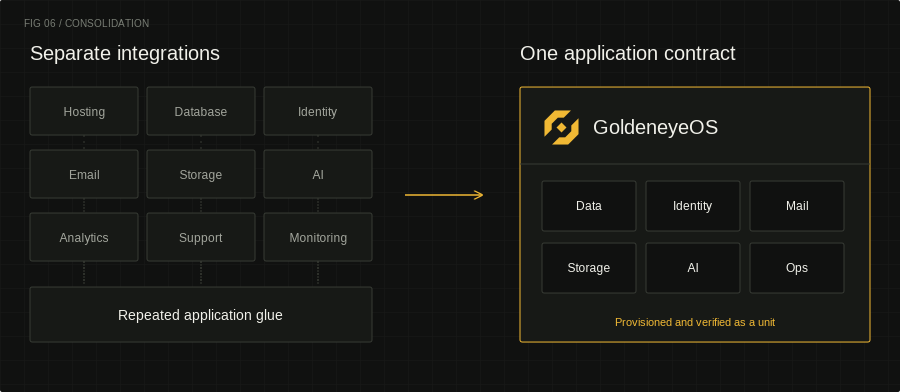
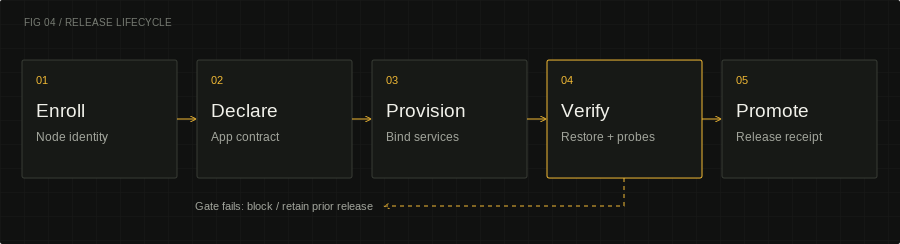
The first run is simple: install the signed release on a Linux server, add the server to your fleet, describe your app once — and GoldeneyeOS sets up everything it needs and checks it works.
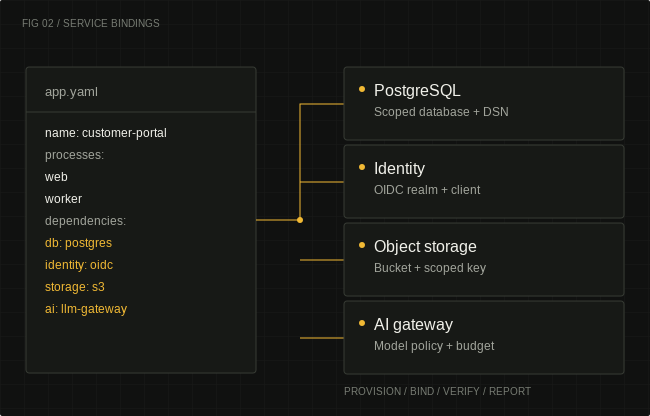
Application contract
The complete example from the master PRD contains placeholder domains, artifact digests and policy references. It is not a working deployment without replacing those values.
apiVersion: cloud.example/v1alpha1
kind: Application
metadata:
  name: customer-portal
  project: demo
  environment: production
spec:
  # Placeholder digest: replace with a real signed OCI image before deployment.
  source:
    image: registry.example.invalid/demo/portal@sha256:0000000000000000000000000000000000000000000000000000000000000000
  placement:
    nodePool: general-eu
    allowedRegions: [eu-west]
    preferredDataLocality: true
  processes:
    web:
      command: ["./portal", "serve"]
      port: 3000
      resources: {cpuMillis: 500, memoryMiB: 512}
    worker:
      command: ["./portal", "work"]
      resources: {cpuMillis: 250, memoryMiB: 256}
  domains:
    - host: portal.example.invalid
      process: web
      tls: true
  dependencies:
    db:
      kind: postgres
      plan: shared
      config: {database: portal, version: "17"}
      bindings:
        - process: web
          env: DATABASE_URL
          credential: runtime-dsn
        - process: worker
          env: DATABASE_URL
          credential: runtime-dsn
    storage:
      kind: object-storage
      plan: shared
      config: {quotaGiB: 10}
      bindings:
        - process: web
          env: S3_BUCKET
          credential: bucket-name
        - process: web
          env: S3_ACCESS_KEY
          credential: access-key
        - process: web
          env: S3_SECRET_KEY
          credential: secret-key
        - process: web
          env: S3_ENDPOINT
          credential: endpoint
    identity:
      kind: oidc
      plan: shared
      config: {passkeys: true}
      bindings:
        - process: web
          env: OIDC_ISSUER
          credential: issuer
        - process: web
          env: OIDC_CLIENT_ID
          credential: client-id
        - process: web
          env: OIDC_CLIENT_SECRET
          credential: client-secret
    mail:
      kind: email
      plan: external
      config: {senderDomain: example.invalid, providerRef: relay-approved}
      bindings:
        - process: worker
          env: SMTP_URL
          credential: scoped-relay-dsn
    ai:
      kind: llm-gateway
      plan: shared
      config: {monthlyBudgetUSD: 100, modelPolicyRef: approved-models}
      bindings:
        - process: worker
          env: LLM_BASE_URL
          credential: gateway-url
        - process: worker
          env: LLM_API_KEY
          credential: scoped-virtual-key
  operations:
    probes:
      - name: web-ready
        process: web
        path: /health/ready
        intervalSeconds: 60
        freshnessSeconds: 180
      - name: worker-output
        process: worker
        checkRef: worker-output-progress
        intervalSeconds: 300
        freshnessSeconds: 900
    recovery:
      required: true
      backupPolicyRef: nightly-encrypted-offsite
      restorePolicyRef: weekly-isolated-drill
      requireVerifiedBeforeDataChange: true
    rollback:
      autoStateless: true
    agentPolicyRef: portal-agent-bounded
Fleet contract
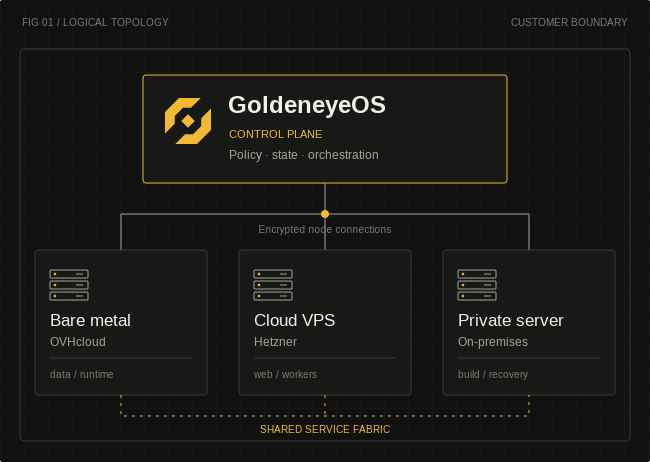
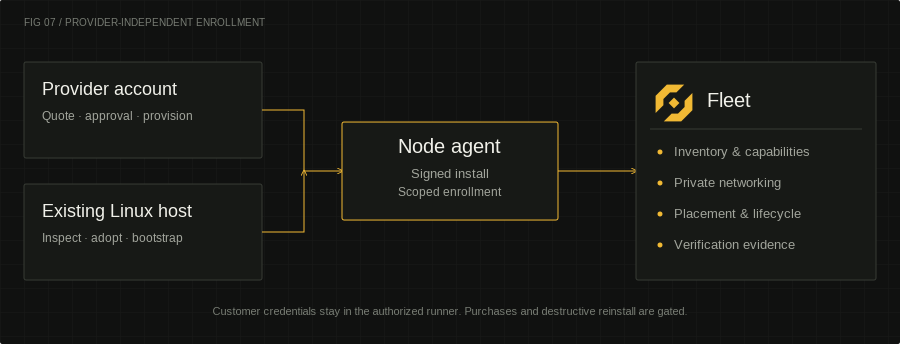
Example mixed-provider topology: adopted data node, managed VPS pool and local build node. All provider purchases require approval.
# Illustrative desired topology, not an executable provider order. Values and policy references are placeholders.
apiVersion: cloud.example/v1alpha1
kind: Fleet
metadata:
  name: studio-cloud
spec:
  controlPlane: self-hosted
  providers:
    - name: ovh-account
      adapter: ovh-dedicated
      credentialRef: local://providers/ovh
    - name: hetzner-account
      adapter: hetzner-cloud
      credentialRef: local://providers/hetzner
  nodePools:
    - name: database
      roles: [data]
      providerAccount: ovh-account
      ownership: adopted
      regionPolicy: eu-only
      desiredNodes: 1
    - name: general-eu
      roles: [app, edge]
      providerAccount: hetzner-account
      ownership: managed
      regionPolicy: eu-only
      desiredNodes: 2
      createPolicy: require-current-quote-and-approval
    - name: local-build
      roles: [build]
      adapter: generic-linux
      ownership: external
      desiredNodes: 1
  network:
    mode: routed-private-overlay
    publicExposure: explicit
  backup:
    destinationRef: local://backups/independent-offsite
    requireIndependentFailureDomain: true
  policies:
    automaticPurchases: false
    destructiveReinstall: approval-required
    providerCredentials: customer-runner-only
    hostedControlPlaneRequired: false
Verification receipt
Structured evidence for a functional check — the shape of the proof every check produces.
{
  "schemaVersion": "0.1",
  "receiptId": "rcpt_example_001",
  "installationId": "inst_demo",
  "subjectId": "svc_demo_db",
  "checkId": "postgres-functional-v1",
  "operationId": "op_example_001",
  "vantage": {"kind": "application-network", "ref": "app_demo_worker"},
  "startedAt": "2026-11-24T20:00:00Z",
  "finishedAt": "2026-11-24T20:00:03Z",
  "expiresAt": "2026-11-24T20:05:03Z",
  "coverage": {"expected": 2, "observed": 2, "emptyAllowed": false},
  "assertions": [
    {"name": "synthetic-round-trip", "result": "pass"},
    {"name": "cross-app-credential-denial", "result": "pass"}
  ],
  "attesterRef": "node_demo_01",
  "result": "verified",
  "reason": "Both required synthetic assertions passed. Illustrative fixture, not live evidence.",
  "evidenceRef": "local://demo/evidence/001"
}
APIs and SDKs
Machine-readable schemas and provider integration contracts — the engineering inputs for building on GoldeneyeOS.
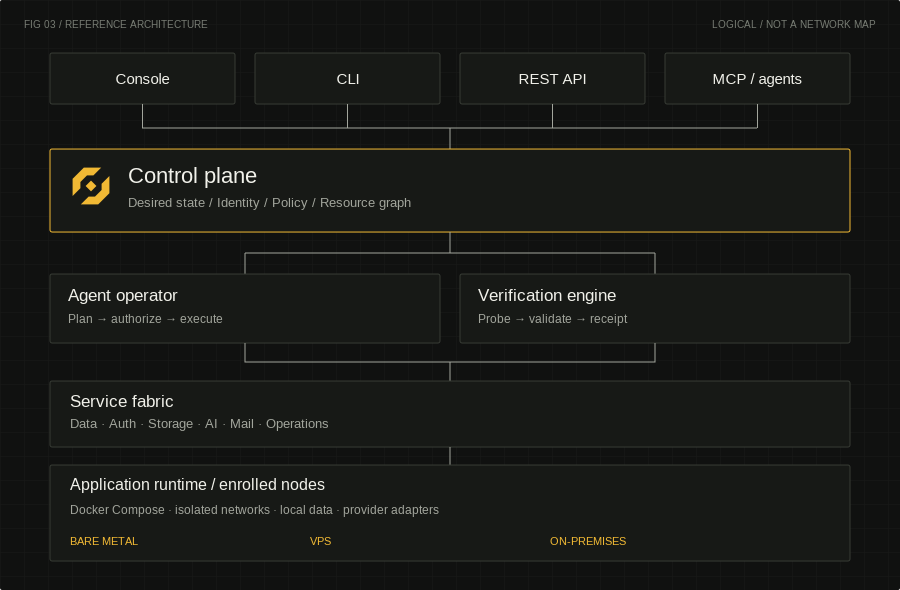
Architecture graphics
Editable vector artwork for documentation, marketing and engineering communication.